Employee recognition
Employee recognition is the practice of acknowledging your people for the contributions they make, the behaviours they demonstrate, and the results they deliver. MELP is an all-in-one employee recognition platform that brings together staff appreciation, gamified rewards, and 360-degree recognition in a single, mobile-first app, so every colleague feels valued.

of employees feel that recognition affects their motivation to succeed at work
of employees agree that being recognised for their contributions improves their engagement
Employee recognition
in just a few clicks
Building recognition at work into your daily routine does not have to be complicated. MELP gives HR leaders and managers the tools to deliver meaningful colleague recognition across every team and location.

Choose who to recognise
With 360-degree recognition for employees, you can show appreciation to colleagues at every level and in every direction.

Add a personal touch
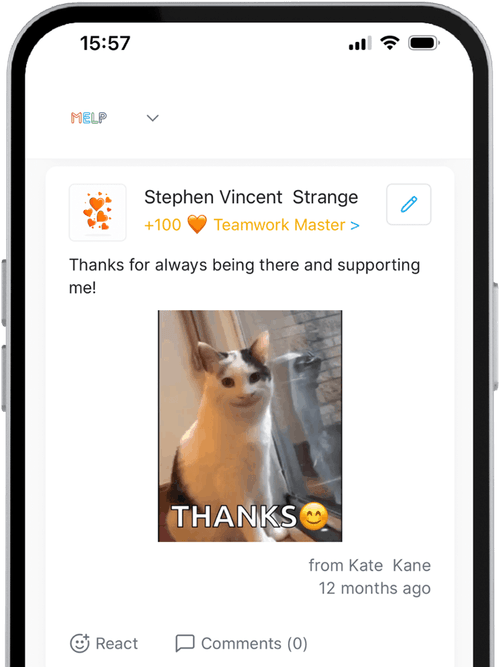
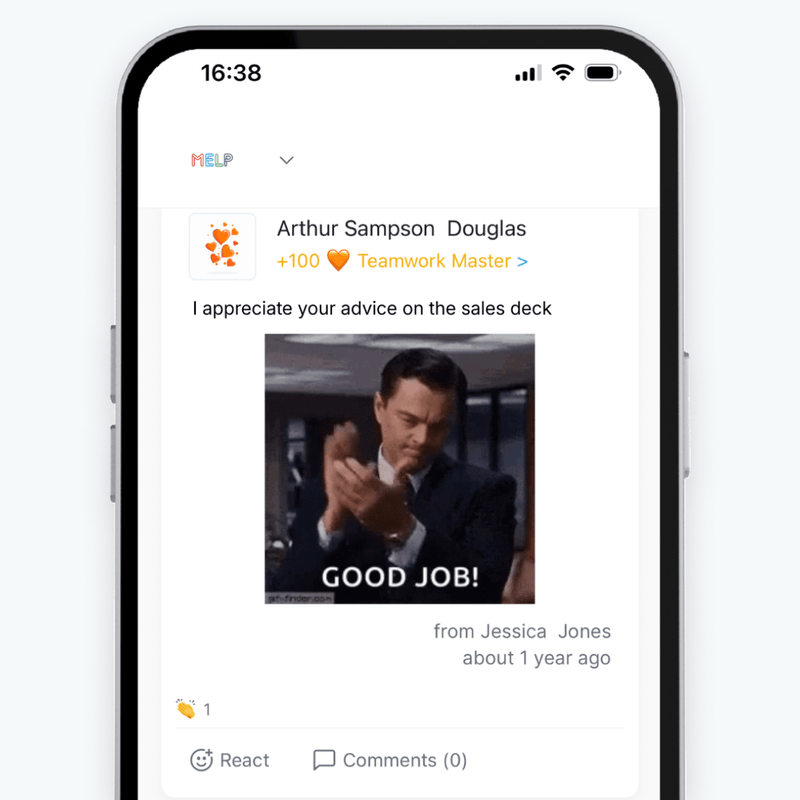
Add a personal message, inside joke, GIF, image, or any other attachment to make your workplace recognition fun and engaging.

Choose a reward
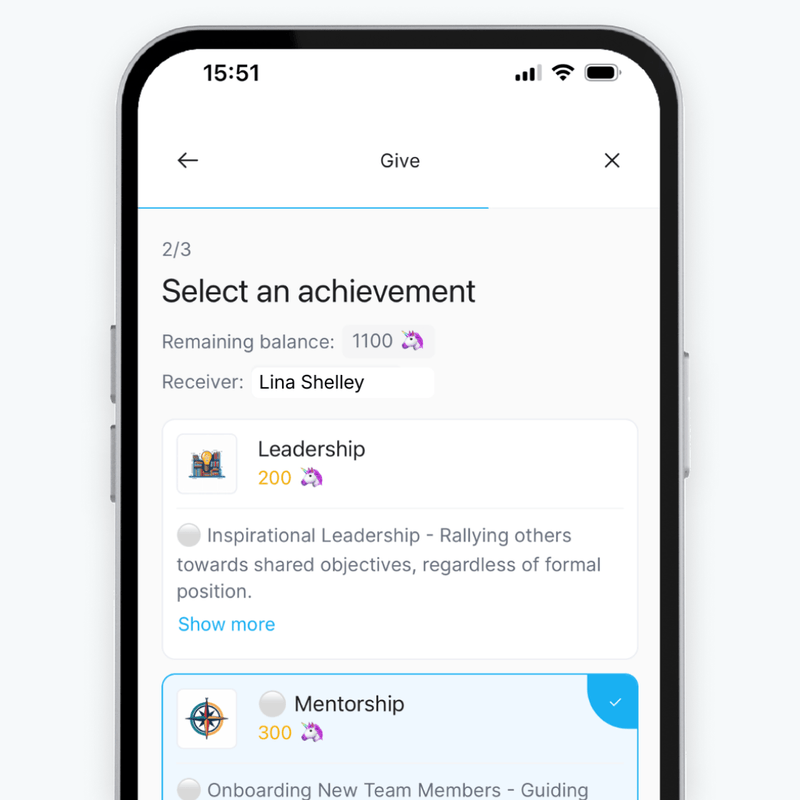
Send recognition points from your token wallet. Earn and share points with colleagues, and exchange them for tangible rewards in the MELP shop.

Share with everyone
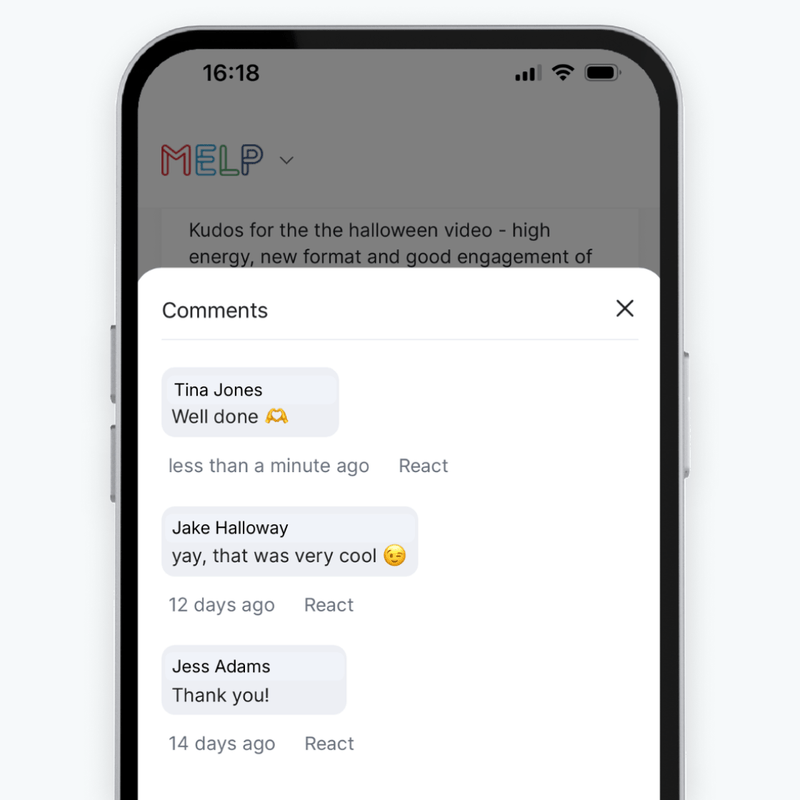
Your recognitions will appear in a shared feed visible to all employees, building a culture of staff appreciation across the organisation.
Staff appreciation that turns into engagement
Foster a culture of recognition in the workplace and turn everyday appreciation into measurable engagement and results.
Living the values
Employee recognition helps employees live by the organisation's values every day, reinforces your mission, and encourages the team to achieve goals together.
Gamified experience
Distribute virtual points and tokens to encourage desired behaviours and boost employee motivation through work recognition that feels engaging.
Rewards
Turn gratitude into tangible rewards by allowing your employees to redeem collected points for a prize of their choice from the MELP online shop.
“We enjoy the simplicity of administration and the automation of certain processes.”


“People are always looking for proof of how much the company cares about them. When they get that proof, they tend to be more loyal and don’t look for alternatives elsewhere. Fostering the company culture and communicating our values on the MELP platform is extremely important to us.”


What is employee recognition?
The employee recognition definition is straightforward: it is the ongoing practice of acknowledging your people for their efforts, behaviours, and results in a way that feels genuine and timely. It goes well beyond the annual performance review or an occasional "well done" from a senior manager. Effective recognition is regular, specific, and connected to what actually matters within your organisation.
It is also worth distinguishing recognition from reward. Recognition is about making someone feel seen and valued. Reward is the tangible expression of that appreciation, whether that is a gift card, redeemable points, or another meaningful incentive. Both have a role to play, but recognition without genuine human acknowledgement quickly loses its impact.
Different types of recognition in the workplace can flow in multiple directions: from manager to employee, between peers, and even upward through the organisation.
Why employee recognition is important
Employee recognition in the workplace is not a nice-to-have. For HR leaders, it is a strategic priority with measurable outcomes. The employee recognition statistics are clear: 83.6% of employees feel that recognition at work affects their motivation to succeed, and 81.9% agree that being recognised improves their engagement.
When people feel appreciated, they work harder, stay longer, and bring more of themselves to their roles.
Workplaces without consistent recognition tend to look very different. Low morale spreads quietly, disengagement becomes the default, and staff turnover rises as people leave organisations that fail to make them feel valued.
By contrast, a structured employee recognition scheme builds more cohesive teams, stronger manager relationships, and a culture that people actively want to contribute to. It also strengthens your employer brand, making it easier to attract new talent in competitive UK markets.
Benefits of employee recognition
When staff appreciation is embedded into everyday working life rather than treated as an occasional gesture, it delivers measurable benefits of employee recognition for both the organisation and its people. MELP supports these outcomes through a structured, gamified recognition system that works for all employees, regardless of role or location.
- Higher employee motivation: Regular recognition reinforces the connection between effort and appreciation, driving discretionary effort and encouraging people to bring their best to every task.
- Stronger employee engagement: Recognised employees feel more connected to their organisation's purpose and more committed to its goals, one of the most consistent drivers of high performance.
- Reduced staff turnover: When people feel genuinely valued, they are far less likely to look elsewhere. Recognition directly addresses one of the most common reasons employees give for leaving.
- Improved team culture: Team recognition awards build horizontal bonds across the workforce, creating a shared sense of belonging and a community of gratitude that is visible to everyone.
- Reinforcement of company values: Values-based recognition connects everyday appreciation moments to the behaviours and principles your organisation stands for, making your culture tangible rather than aspirational.
- Better manager-employee relationships: Recognition gives managers a practical, frequent way to build genuine trust with their teams, improving communication and day-to-day working relationships.
- Stronger employer brand: Organisations known for recognising their people attract better candidates and benefit from higher levels of employee advocacy across the UK talent market.
Recognition is one of the most cost-effective tools in any people strategy. Done consistently and thoughtfully, it delivers a measurable return in the metrics that matter most to HR leaders and senior stakeholders alike.
Employee recognition in practice
Effective employee recognition does not happen by accident. Without a structured approach, it tends to be ad hoc, inconsistent, and heavily dependent on individual managers, leaving many employees feeling overlooked. MELP addresses this by embedding a practical, easy-to-use staff recognition system within its wider employee engagement platform.
The MELP recognition flow is designed to be simple for everyone. Staff select a colleague, write a colleague recognition message, and optionally add a personal touch such as a GIF or image. The recognition is then published to a shared company-wide feed, turning individual moments of appreciation into collective cultural signals.
Alongside messages, MELP supports a points and token wallet system that adds a gamified dimension: employees accumulate points that can be redeemed for tangible rewards in the MELP shop, including employee recognition gifts and gift cards from well-known UK brands.
For organisations that want to go further, values-based recognition allows every appreciation moment to be connected directly to the cultural principles that define the business.
How to use employee recognition as a motivator
Effective employee recognition at work is about driving genuine, sustained motivation rather than simply marking occasions. The employee recognition gamification approach, built around points, token wallets, and a shared recognition feed, encourages frequent and meaningful appreciation at every level of the organisation.
Instant recognition, delivered via a mobile-first app, ensures that the motivational impact of timely appreciation is captured at its peak rather than lost in a slow approval process.
The 360-degree employee recognition model ensures that appreciation can flow in every direction: employees can recognise peers directly, managers can acknowledge their teams, and recognition can travel upward as well. Tying recognition to company values reinforces the behaviours your organisation most wants to celebrate, creating a behaviour-shaping dynamic that no policy document can replicate.
The whole process takes just a few clicks, with the option to add a personal message, GIF, or image to make appreciation feel specific and genuine rather than generic.
The essentials of meaningful employee recognition
Not all recognition is equally effective. For appreciation to truly motivate and engage employees, it needs to be built on a set of core principles. Getting these right is what separates a recognition programme that transforms culture from one that quietly goes unused.
- Timeliness: Recognition is most motivating when delivered close to the moment it celebrates. Delayed or batched appreciation loses much of its impact as the emotional connection between effort and acknowledgement fades.
- Specificity: A generic "good job" carries far less weight than recognition that names exactly what someone did and why it mattered. Specificity is what makes people feel truly seen rather than simply ticked off a list.
- Frequency: A culture of appreciation is built through consistent, everyday recognition rather than infrequent high-ceremony events. More frequent, lower-threshold recognition consistently outperforms sporadic grand gestures.
- Inclusivity: Recognition must reach every employee, including those in frontline, deskless, or remote roles who are often systematically underrecognised. A mobile-first platform removes the access barriers that prevent appreciation from reaching the people who need it most.
- Personalisation: Employees differ in how they prefer to receive recognition. Effective programmes give people genuine choice in how their appreciation is expressed and how any associated rewards are redeemed.
- Values alignment: Recognition connected to organisational values becomes a cultural reinforcement tool, not just a motivational one. It closes the gap between what your organisation says it stands for and what it actually celebrates in practice.
- Equity: Recognition programmes must be monitored to ensure appreciation is distributed fairly across gender, ethnicity, tenure, and location. Systematic underrecognition of particular groups erodes belonging and trust from the inside out.
MELP's platform is built around each of these essentials, from real-time mobile recognition and personalised rewards to values-based programme design and analytics that help HR teams keep workplace recognition consistent, fair, and effective over time. For practical employee recognition examples that put these essentials into action, see our dedicated guide.
Overcoming common challenges in employee recognition
Implementing a workplace employee recognition programme is one thing; making it work consistently is another. HR leaders frequently encounter familiar obstacles that can undermine even well-intentioned initiatives.
Inconsistency across teams is one of the most common problems. When recognition is left entirely to individual managers, some teams develop a vibrant culture of appreciation while others receive almost none. MELP addresses this by giving every manager and employee the same structured employee recognition tools, creating a consistent baseline that does not depend on individual habit or personality.
Managers who feel unsure how to recognise their people present a related challenge. MELP's guided recognition flow removes much of that uncertainty, and the shared recognition feed provides a visible example of what good appreciation looks like in practice.
For recognition that feels tokenistic or impersonal, MELP encourages specificity through personalised messages and values-based recognition that connects appreciation to real behaviours rather than generic praise.
Reaching deskless and remote employees remains a persistent challenge across UK retail, logistics, hospitality, and healthcare sectors. MELP's mobile-first app ensures that every employee can give and receive recognition from their phone, closing the appreciation gap that disproportionately affects frontline workforces.
And for programmes that lose momentum over time, MELP's gamified mechanics and recognition analytics help HR teams monitor participation, identify where engagement is falling short, and act before disengagement sets in.
Improving your employee recognition with MELP
MELP brings together the full toolkit for effective recognition: 360-degree recognition, gamified points and token wallets, a shared social recognition feed, values-based programme design, and analytics to track adoption and impact. Crucially, recognition does not sit in isolation within MELP.
It works alongside internal communication and personalised employee benefits in a single integrated platform, creating a joined-up experience in which recognition for employees is reinforced at every touchpoint.
MELP is mobile-first, accessible to deskless employees, available in multiple languages, and trusted by more than 70,000 users. Whether you are building a recognition programme from scratch or refreshing one that has lost momentum, MELP gives you the structure and support to do it properly.
Request a demo today or get in touch with the MELP team to discover how you can build a genuine culture of appreciation across your organisation.
Ready to improve employee recognition?
FAQ about employee recognition

Employee recognition is the ongoing practice of acknowledging your people for their efforts, behaviours, and results in a way that feels genuine and timely. It matters because 83.6% of employees say recognition affects their motivation to succeed, and 81.9% agree that being recognised improves their engagement. Consistent recognition reduces staff turnover, strengthens culture, and builds more cohesive teams.
Staff appreciation in practice means recognising contributions regularly, specifically, and visibly. It includes peer-to-peer recognition between colleagues, manager-led acknowledgement, values-based appreciation tied to organisational goals, and optional rewards such as redeemable points. Effective recognition is timely, inclusive of deskless and remote employees, and embedded into everyday working life rather than limited to annual reviews.
MELP's recognition feature is a structured, gamified system that makes it easy for employees at every level to appreciate one another. It combines recognition messages, a company-wide shared feed, a points and token wallet, and a rewards shop, all accessible via the MELP mobile app.
Yes, companies can design their own recognition programme tailored to their culture and values, configure how points work, decide whether recognition is tied to rewards, and align appreciation with the specific behaviours they most want to celebrate. MELP's team supports the setup from day one.
Yes, employees earn and share recognition points through the token wallet, which can be redeemed for tangible rewards in the MELP shop. The rewards catalogue includes thousands of products and gift cards from well-known UK brands, giving employees real choice in how they use their points.
Yes, employees can directly recognise their colleagues, fostering a culture of gratitude at all levels.
Yes, managers and team leaders can recognise individuals or entire teams, reinforce company values through their appreciation messages, and keep their people motivated on a day-to-day basis. MELP's 360-degree model means recognition flows in every direction, not just top-down, helping to build a genuine culture of appreciation across the whole organisation.